
Engineered foam support
Sprayed structural polyurethane foam creates a defined support geometry around the pipe, reducing dependency on imported aggregate.
What is HydroFoamer?
HydroFoamer is a controlled installation method for restrained buried pipelines. It replaces aggregate-heavy bedding and embedment with engineered sprayed polyurethane foam, controlled installation and auditable as-built evidence.
Sprayed structural polyurethane foam creates a defined support geometry around the pipe, reducing dependency on imported aggregate.
Pipe position, foam application and restraint are managed as part of one repeatable installation sequence.
Installation data can be captured, checked and handed over as auditable construction evidence.
The result is less imported material, fewer truck movements, lower execution risk and a more verifiable buried pipeline installation.
Support geometry
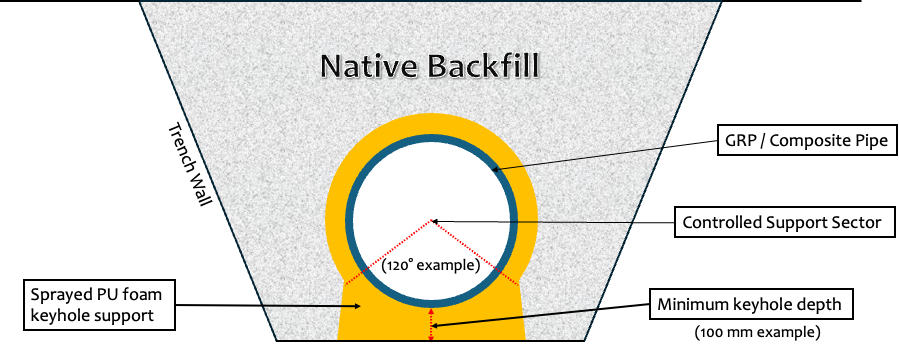
HydroFoamer applies sprayed structural polyurethane foam in a defined keyhole geometry around the pipe. The foam provides controlled support and restraint while allowing native backfill to replace much of the imported bedding and embedment material normally required.
HydroFoamer changes the construction activity around the pipe: less imported material dependency, more controlled installation, and stronger evidence for review and handover.
Material-heavy bedding and embedment can drive imported aggregate demand, haulage, spoil movement and backfill operations.
Engineered sprayed foam support reduces dependency on imported aggregate and gives the support geometry a defined installation sequence.
Installation quality can depend heavily on site execution, compaction, access, plant movement and manual checks.
Pipe positioning, sprayed foam application and restraint are managed through a controlled installation sequence.
Once backfilled, many installation conditions are difficult to verify directly.
Measured installation data can support auditable as-built evidence and quality assurance.
Imported aggregate and transport can dominate construction activity, especially on remote or constrained sites.
Reduced imported material can reduce truck movements, excavation burden, construction access requirements and associated emissions.
Engineering evidence
Future Pipe Industries has confirmed that, for HydroFoamer restrained installations where pipe alignment, movement and settlement are controlled and verified, the designer may consider the nominal joint deflection capacity of the pipe system.
This is important because HydroFoamer changes not only the physical installation method, but also the uncertainty assumptions behind buried composite pipe design.
The homepage is a starting point. Serious project conversations usually move into method review, PACE scenario modelling, evidence review or partner discussion.
Review the controlled installation sequence, keyhole support geometry, PGMS workflow and as-built handover route.
Use PACE to compare the full installation system rather than only the pipe price.
Understand where HydroFoamer is near-term, adjacent or still subject to future qualification.
Read the engineering basis, Future Pipe Industries recognition and measured installation-control framework.
Assess sustainability through construction activity avoided, not generic green claims.
Find public resources, controlled technical resources and the FAQ for early project questions.
Project-specific results depend on trench geometry, access, ground conditions, pipe specification, foam design, productivity assumptions and commercial inputs.